


Key Takeaways
- ✔Social Anxiety Disorder is about fear of judgment, while GAD relies on excessive worry across multiple areas.
- ✔Both conditions produce overlapping symptoms that include a racing heart, muscle tension, and disrupted sleep, which can confuse both conditions.
- ✔Social anxiety and GAD frequently occur together. Comorbid cases show greater severity and functional impairment than either condition alone.
- ✔They are not diagnosed by any test. Only a professional provider can evaluate the condition and accurately diagnose it.
- ✔Cognitive behavioral therapy is the most common treatment for both of these.
Social anxiety disorder (SAD) is the fear of judgment in social situations. Generalized anxiety disorder is chronic worry across multiple areas of life. The major difference is what the anxiety is about. A person can experience one, both, or neither, and the two conditions are diagnosed and treated differently.
Generalized anxiety is not a clinical diagnosis. People often use the term to describe either normal, situational anxiety or generalized anxiety disorder (GAD), a recognized mental health condition. In this article, “general anxiety” refers to GAD so you can clearly compare it with social anxiety disorder.
Social Anxiety vs GAD at a Glance
| Feature | Social Anxiety Disorder | Generalized Anxiety Disorder |
| Main concern | Being judged, embarrassed, rejected, or observed | Excessive worry about multiple areas of life |
| Common focus | Social or performance situations | Work, health, finances, family, responsibilities, and uncertainty |
| Core thought | “What will they think of me?” | “What if something goes wrong?” |
| Timing | Before, during, or after social situations | Persistent worry that can occur across different situations |
| Avoidance pattern | Avoiding social situations, public speaking, eating in public, or meeting new people | May involve reassurance-seeking, procrastination, or avoiding situations connected to worry |
| Physical symptoms | Sweating, trembling, blushing, rapid heartbeat, nausea | Muscle tension, fatigue, restlessness, sleep problems, difficulty concentrating |
| Emotional theme | Fear of negative evaluation | Persistent worry and difficulty tolerating uncertainty |
| Common treatments | CBT, particularly exposure-based approaches; medication when appropriate | CBT focused on managing worry; medication when appropriate |
What Is Social Anxiety Disorder?
Social anxiety is a mental health condition defined by the intense fear of judgement or being negatively evaluated in social situations. Its meaning goes beyond ordinary nervousness. The fear is strong enough to drive avoidance or to be endured only with significant stress.
According to NIMH, the condition shows up in situations such as speaking in public, meeting new people, asking for help, or going for a job interview. In addition to these, eating in front of others and other ordinary daily actions can trigger the same fear because the underlying concern is being watched.
What Is Generalized Anxiety Disorder?
GAD is a psychiatric condition marked by excessive worry about multiple areas of life that persists for months or more. A person with generalized anxiety disorder might worry about health, finances, work performance, family safety, and everyday responsibilities, sometimes all in the same day. Unlike social anxiety, it does not need a social audience to activate.
What Do Social Anxiety and GAD Have in Common?
Despite the differences, both these conditions have a few similar features. They produce a similar stress response and also respond to the same core treatment approaches. The other common factors include the following:
- Both involve excessive fear and worry that’s out of proportion to the actual situation.
- They bring on physical symptoms like a racing heart, fatigue, or disrupted sleep.
- They share an anticipatory phase where a person feels anxious before anything happens.
- They share the same CBT treatment approach.
- These are commonly misread as personality traits.
- They have similar co-occurring conditions like PTSD and depression.
SAD vs GAD: Symptoms Compared
Both conditions share similar symptoms; that’s why they are often confused. The main difference is what anxiety is about and how it affects thoughts and behavior. The common symptoms are given to let you know if you have social anxiety disorder or GAD:
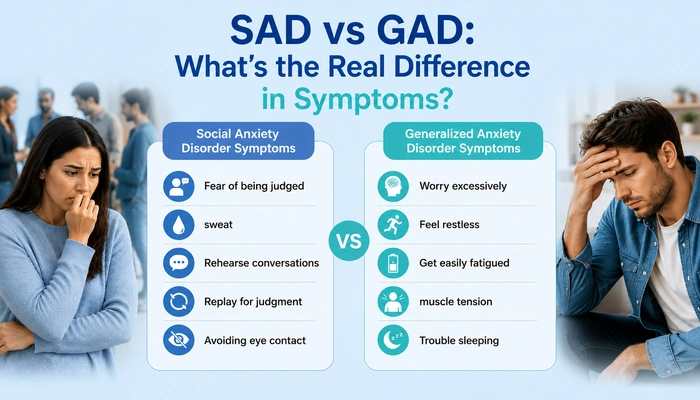
Social Anxiety Disorder Symptoms
- Fear of being judged or watched
- Avoid performance situations or face them with intense distress
- Blush, sweat, tremble, or feel nauseated in social gatherings
- Rehearse the conversations beforehand
- Replay social interactions to find any sign of judgment
- Avoid eye contact or speak in a quiet voice that is difficult to understand
- Experience a racing heart or blank mind when placed on the spot.
Generalized Anxiety Disorder Symptoms
- Worry excessively about everyday events
- Struggle to stop worrying once it starts
- Feel restless
- Get easily fatigued
- Experience muscle tension, headaches, or stomach problems
- Difficulty concentrating
- Trouble sleeping due to ongoing worry
- Seek frequent reassurance from others
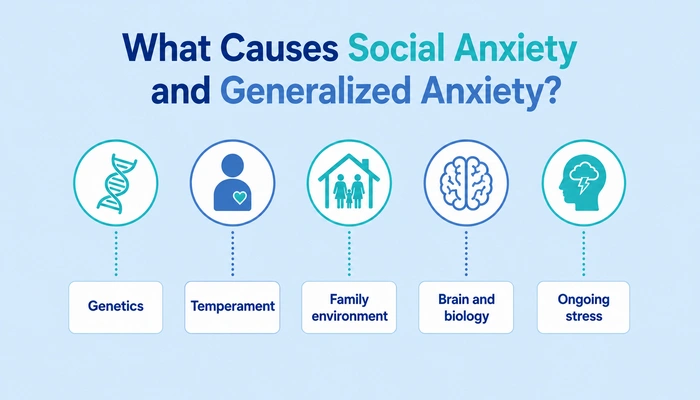
What Causes Social Anxiety and Generalized Anxiety?
Neither of these conditions is caused by a single factor. They develop from a combination of genetic, environmental, and other factors. A detailed comparison table is below:
| Causing Factor | Social Anxiety Disorder | Generalized Anxiety Disorder |
| Genetics | Runs in families, raising the chances of a strong fear response to social judgment | Also tends to run in families, tied to worry and anxiety |
| Temperament | Kids who were unusually shy or emotionally guarded early on are more prone to it later in life | People with a naturally sensitive temperament are more likely to develop it |
| Family environment | Growing up with harsh criticism or rejection | Chaos, conflict, or picking up anxious habits from family members can feed chronic worry |
| Stressful experiences | Being bullied, humiliated, or rejected tends to lock the fear in place | Trauma can trigger persistent worry |
| Ongoing stress | Repeated bad social experiences deepen the fear of being judged over time | Stress that never lets up makes the worry harder to control |
| Brain and biology | Comes down partly to how the brain processes fear | Comes down partly to how the brain handles worry and stress |
| Overall pattern | The anxiety stays fixed on social situations | The anxiety spreads out, touching nearly every part of life |
What Do People With Social Anxiety and Generalized Anxiety Worry About?
Social anxiety disorder usually focuses on one question: what will people think of me? But GAD widens the worry to nearly everything.
Someone with fear of people worries, “What if I stumble over my words and the interviewer thinks I’m incompetent?” Someone with GAD worries, “What if I don’t get the job? What will happen financially? What if I can’t find another one?” The event is identical. The feared outcome is not. This is a simple example of how a person worries in each condition.
Can You Have Social Anxiety and GAD at the Same Time?
Yes, both these conditions frequently occur together. The occurrence of both increases the overall anxiety and functional impairment compared to having either alone. These conditions can cause different physical signs, like an increased heartbeat, trouble sleeping, and muscle tension.
As many as 50% of patients with a primary anxiety disorder meet criteria for at least one additional anxiety disorder. Among people with primary social phobia specifically, roughly 24% also met criteria for generalized anxiety disorder, and those with comorbid GAD showed greater severity across social anxiety, generalized anxiety, depressed mood, and functional impairment than those with social phobia alone (Mennin et al., 2000, Journal of Anxiety Disorders).
A few points follow from this:
- Both conditions can occur in the same person.
- The worries in each condition don’t have to share the same focus. Someone might fear being judged in social settings while constantly worrying about health, work, money, or family.
- Having symptoms of both does not automatically mean a person meets criteria for both disorders.
- A clinician evaluates the overall pattern: what the person worries about, what triggers it, how long it has lasted, whether avoidance is present, and how much distress and impairment result.
How Are Social Anxiety and GAD Diagnosed?
Healthcare providers do not diagnose either of the disorders from a single symptom. They evaluate the overall pattern of anxiety. The evaluation covers the following factors:
- Identify what the anxiety is generally about.
- Determine the factors that trigger anxiety and how specific those triggers are.
- Assess how many areas of life the worry spans
- Measure how long the symptoms have persisted
- Check if the avoidance behavior is present and how extensive it is.
- Determine how much the symptoms interfere with daily functioning, school, or work.
- Rule out whether another condition, such as depression, adhd, or an anxiety disorder, better explains the symptoms.
The World Health Organization’s ICD-11 classifies both these conditions as separate diagnoses within a distinct group of anxiety and fear-related disorders. It reflects the same principle: shared symptoms do not equal shared diagnoses.
Can an Online Test Diagnose Social Anxiety?
No, a test cannot tell you if you have SAD for sure. Online tests just give you a score that shows how severe your symptoms can be. But these tests are not enough. Only a professional healthcare provider can diagnose your exact condition. They use the standard DSM-5TR criteria for anxiety by ruling out other similar conditions.
How Are SAD and GAD Treated?
Both these conditions are treated using a combination of approaches. Psychotherapy is the first-line treatment that helps to overcome social anxiety disorder as well as GAD. It involves the following therapies:
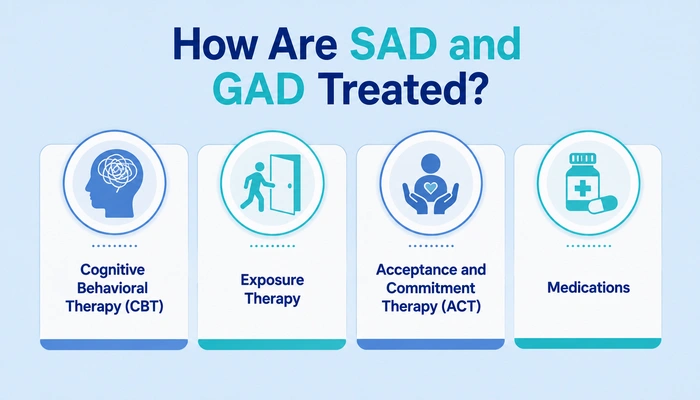
Cognitive Behavioral Therapy (CBT)
This therapy is a structured form of psychotherapy that helps people identify and change unhelpful patterns of thinking. It also helps change behaviors that contribute to emotional distress. With CBT, you can deal with current problems rather than digging deep into your past. You also learn to spot extreme thoughts and false ones.
Exposure Therapy
Exposure therapy helps you gradually face the situations, thoughts, or activities that you fear or avoid. With repeated exposure and practice, you will learn to cope with these situations and also learn that they are manageable.
Acceptance and Commitment Therapy (ACT)
This is an action-oriented therapy that teaches you to accept difficult thoughts instead of fighting them. It helps to focus on the present, identify personal values, and take meaningful actions when anxiety and other uncomfortable emotions are present.
Medications
Medication options overlap between the two conditions. Treatment is individualized: the right combination of therapy and medication depends on symptom severity, co-occurring conditions, and personal treatment history, which is why a professional evaluation matters more than matching symptoms to a table.
Social Anxiety vs Shyness vs Introversion
Social anxiety disorder is not the same thing as being shy or being introverted. Shyness and introversion describe personality traits. SAD is a diagnosable condition defined by significant fear, avoidance, distress, or impairment connected to social situations and the fear of negative evaluation.
A shy person may feel uncomfortable at a party but still attend, function, and recover quickly afterward. An introverted person may prefer solitude and find socializing draining without fearing judgment at all. Someone with social anxiety disorder experiences fear intense enough to interfere with work, school, or relationships, and the fear persists regardless of how much the person would otherwise enjoy connecting with others.
Get Help to Overcome Social Anxiety or GAD at Brainpower Wellness Institute
Persistent anxiety, whether it’s social or generalized, doesn’t have to be something you just manage on your own. If it’s been going on for weeks or longer, getting in the way of work, school, or relationships, pushing you to avoid everyday situations, or just feels impossible to control, that’s the point to reach out.
At Brainpower Wellness Institute, our team evaluates the specific pattern behind your anxiety instead of treating every case the same way, because what’s actually driving your symptoms determines what will actually help.
Why people choose us:
- Board-certified psychiatrists, psychiatric nurse practitioners, and therapists all in one place.
- Personalized treatment plans built around CBT, exposure therapy, and medication management where needed
- New patients accepted, with appointments often available within 48 hours
- Evening and weekend appointments available across most locations
- In-person and telepsychiatry visits, whichever fits your schedule
- Most major insurance plans accepted, including Aetna, Cigna, Anthem, Optum, and Medicare
- 10 locations across California, including Orange, Long Beach, Yorba Linda, Corona, San Diego, San Francisco, Torrance, Fresno, Woodland Hills, and Anaheim.
Contact us at (714) 712-0711 or book an appointment to get started today!